Parallels
The first real turn of the base fundamentals: both feet on the ground, 8 variations (open/closed × forward/backward × left/right).
Parallel Turns are the second stage of the base fundamentals. They are curving movements along an imaginary semicircle, executed with both feet on the ground simultaneously.
There are 8 variations: open/closed × forward/backward × left/right. Each combination trains a different type of balance and body projection.
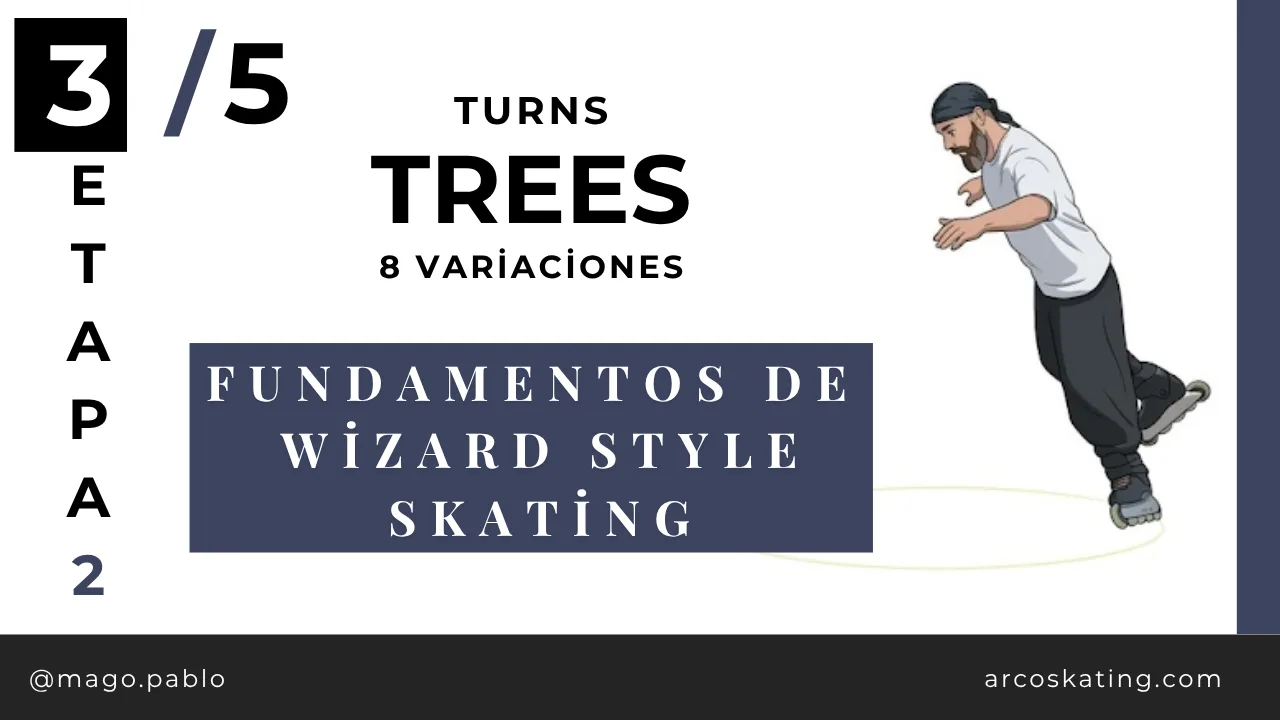
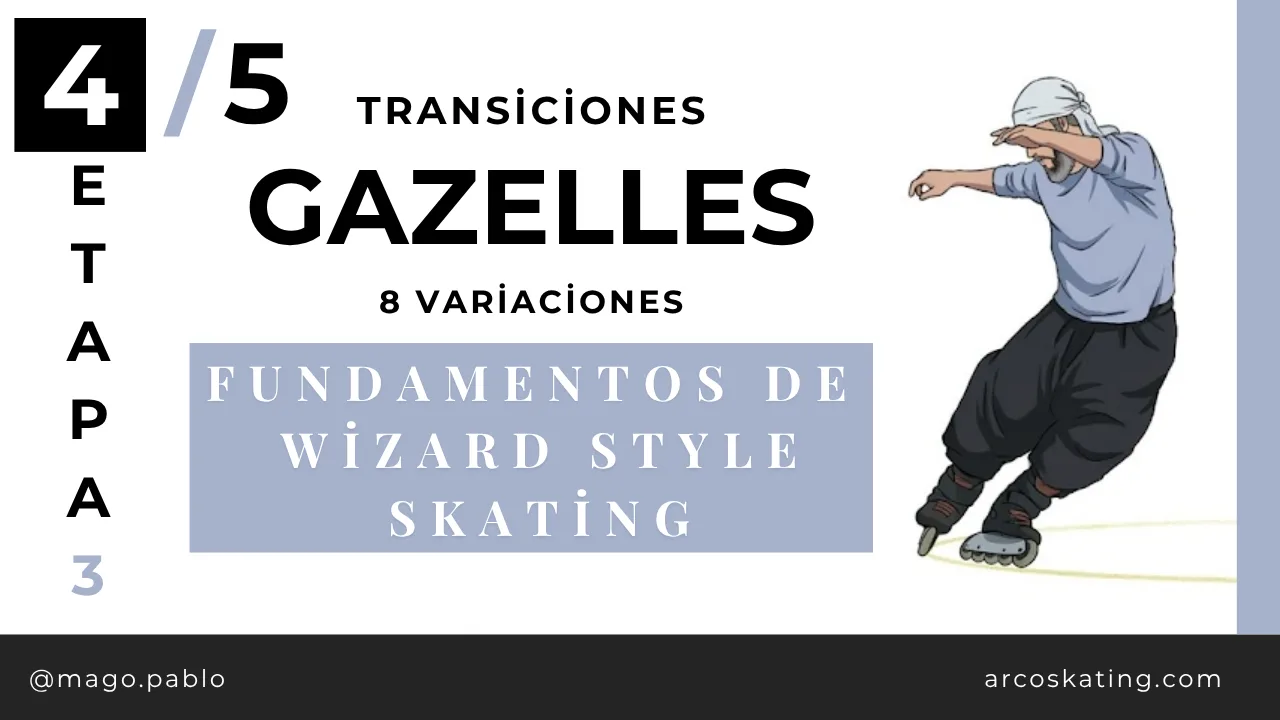
Learning Parallels teaches you to lean without losing your center of gravity. It's the step before Tree (one-foot version) and Gazelle (transition composed of two consecutive Parallels).
Steps
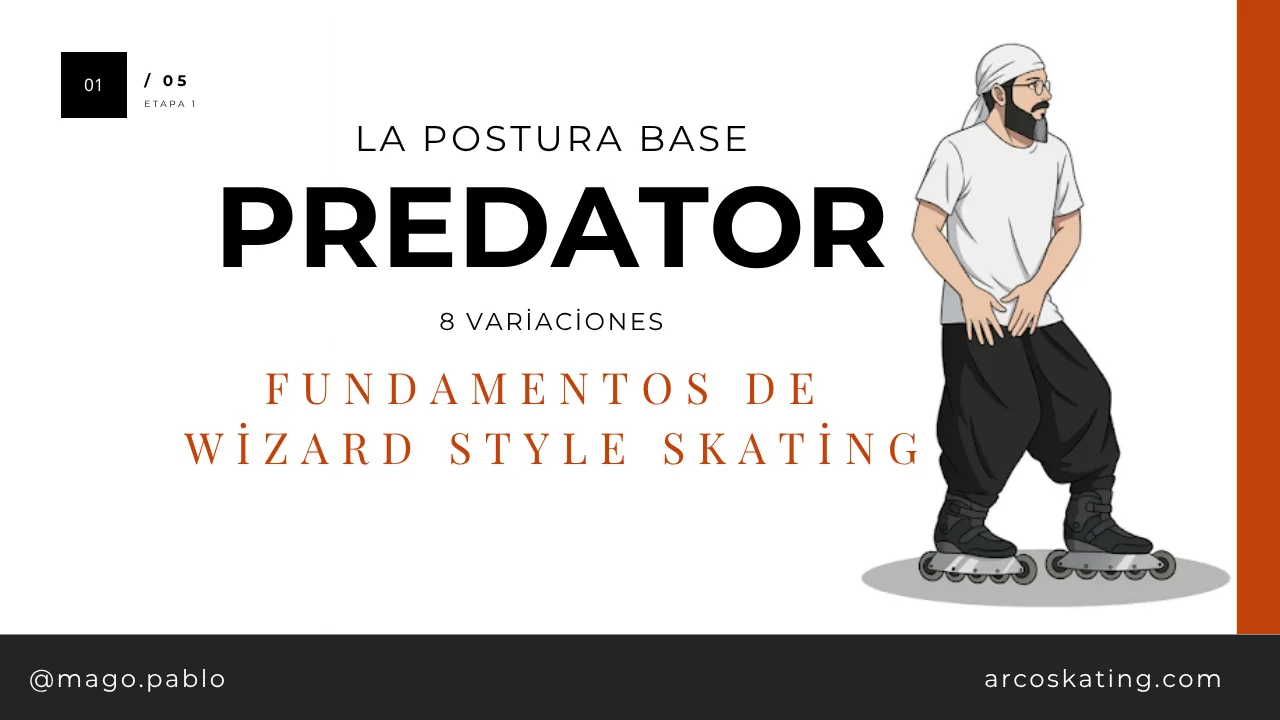
- New concept — edges: each skate has three contact areas with the ground — outer edge, inner edge, and center. Learn to feel deliberate pressure with your ankle toward each one; that pressure is what draws the curve. Without skates, in your Predator stance, play with lateral weight: take your ankle outward, then inward. Just like a motorcycle leans into a curve instead of going straight.
- Build your practice circle: with a string the length of your chest to your arm (~1 m), a keyring on one end and a piece of chalk on the other, draw a wide circle on the floor. It'll be your visual guide for training the 8 variations.
- Diagonal approach — the 4 entries: roll forward in Predator but aiming diagonally at the circle, not toward the center. Travel the 4 diagonals around it without turning yet — you're just building spatial awareness of where the circle sits relative to your body.
- Your first Parallel turn — Front Open Parallel: approach the circle diagonally in Predator. As you enter, change the edges (deliberate pressure to one side of the skate) and let both feet follow the direction of the circle. Shoulders initiate the turn toward the front leg — without torso rotation against the hip: that's why it's called 'open'. Practice it with the right leg leading, then with the left.
- Closed variant (Front Closed Parallel): same entry, but now the torso rotates in the opposite direction of the turn while the feet follow the curve. Practice it with left and right leading. That gives you 4 of the 8 variations.
- Backward (fakie) — complete the 8: same logic skating in fakie. Open or closed position, shoulders drive the torso to open the curve. You cover open/closed × forward/fakie × left/right = 8 total variations.
- Key Parallel tip: both skates stay in contact with the ground at all times. Don't lift toes or heels — that turns the move into a pivot, not a parallel. Let the edges do the work of drawing the curve.
Common mistakes
- Lifting toes or heels: if any part of the skate loses contact, the move becomes a pivot. Both skates roll fully on the ground the whole time.
- Forcing the turn with the hip: the curve is drawn by the edges through ankle pressure; the shoulders only initiate the direction.
- Entering aimed at the center of the circle: the approach is diagonal — aiming at the center closes the curve too early.
- Entering upright, without lean: like a motorcycle, the body enters the curve leaning. Without an edge change there's no parallel — just a skid.
In one sentence
A clean Parallel is edge pressure with both skates rolling: the shoulders set the direction, the edges draw the curve, and the practice circle tells you the truth.
Sources
The nomenclature of families and variations follows the official source. The drills, progressions and teaching concepts around it are ARCO's own elaboration, created to communicate the ideas.