180 Jump + Front Open Lion + Front Closed Lion
Two Lions chained on one curve: a jump entry, a foot change and a clean roll out.
Second episode of Combos of the Week: a 180 jump entry that lands straight into a front open Lion and, with the shoulder rotation, changes feet into a front closed Lion. Two different Lions chained on a single curve.
Here the series starts combining one-foot transitions. If your Lions are already comfortable this will be a piece of cake; if not, the Lions tutorial is the place to solidify that foundation before coming back.
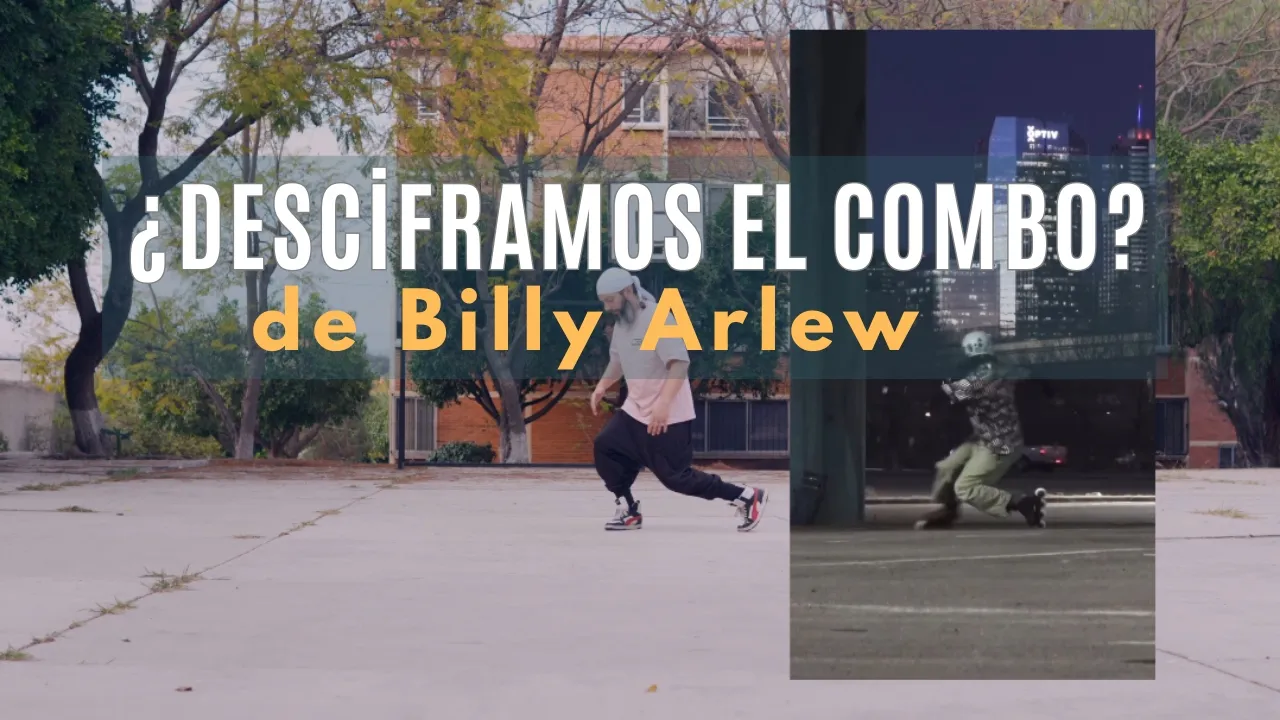
Before the technique comes the visualization: from the camera to the court there is a straight line and, against it, you picture the curved line that will be your trajectory. Shadowing the combo without skates builds proprioception — awareness of your body in the space where you'll skate — and makes it clear that the 180 isn't done on a straight line, it's done diagonally, entering the curve.
The exit's criterion is the clean roll out: the momentum holds across the whole trajectory and, when the foot comes down, the speed doesn't drop — you roll out in the same direction. Each episode's findings and concepts accumulate in the Combos of the Week course.
Steps
- Check the prerequisites: a comfortable front open Lion and front closed Lion separately. Each one's detail lives in the Lions tutorial; here we chain them.
- Visualize before putting your skates on: take a straight reference line in your space, picture the curved line of your trajectory against it and shadow the combo. The 180 goes diagonally, entering the curve — not on a straight line.
- Exercise 1 — 180 from fakie to front: arrive as if you were going to do a back parallel turn, do the 180 and hold the curved direction. That's where the entry ends.
- Exercise 2 — 180 landing on two feet: from the second of that exit, go straight into the front open Lion. You don't need to land on one foot: you land, push and develop the central part.
- Exercise 3 — 180 landing on one foot: the same progression, now landing straight on one foot to enter the front open Lion.
- Exercise 4 — Front open Lion into front closed Lion: keep the shoulder rotation going and let the leg in the air introduce the second Lion. Look for the direction of your trajectory and close.
- Join the three parts on the same curve: 180 (entry), front open Lion (development), front closed Lion (exit). If you lose speed as the foot comes down, the exit isn't a roll out yet: go back to exercise 4.
Common mistakes
- Doing the 180 on a straight line to the front: the jump enters the curve diagonally; if it comes out straight, the rest of the combo fights the trajectory.
- Restarting the rotation between the two Lions: the second one doesn't start from zero — it is introduced by the continuation of the shoulder turn with the leg in the air.
- Braking as the foot comes down: if the speed drops on the close, there was no roll out. Lower your entry speed and repeat until the exit rolls by itself.
- Wanting the full combo too soon: front open into front closed Lion works as a combo on its own, and the 180 goes in once the confidence is there.
In one sentence
Two Lions chained on a curve: the 180 enters diagonally, the front open Lion develops and the front closed Lion closes with a shoulder rotation that never restarts. The visualization before the skates sets the trajectory; the clean roll out confirms the momentum survived the exit.
Frequently asked questions
- What do I need to master before this combo?
- The Lions from the base curriculum, in particular the front open and the front closed separately. The combo doesn't re-teach them: it teaches how to chain them with a foot change on a single trajectory.
- Do I have to land the 180 on one foot?
- No. The exercises separate it on purpose: first you land on two feet and go into the front open Lion from there, then you try landing straight on one foot. They are a progression, not two versions.
- What is a clean roll out?
- That the momentum holds across the whole trajectory: as the foot comes down the speed doesn't drop and you roll out automatically in the same direction. If there is braking, the close isn't there yet.
Sources
The nomenclature of families and variations follows the official source. The drills, progressions and teaching concepts around it are ARCO's own elaboration, created to communicate the ideas.